
Oracles
It's tough to make predictions, especially about the future.

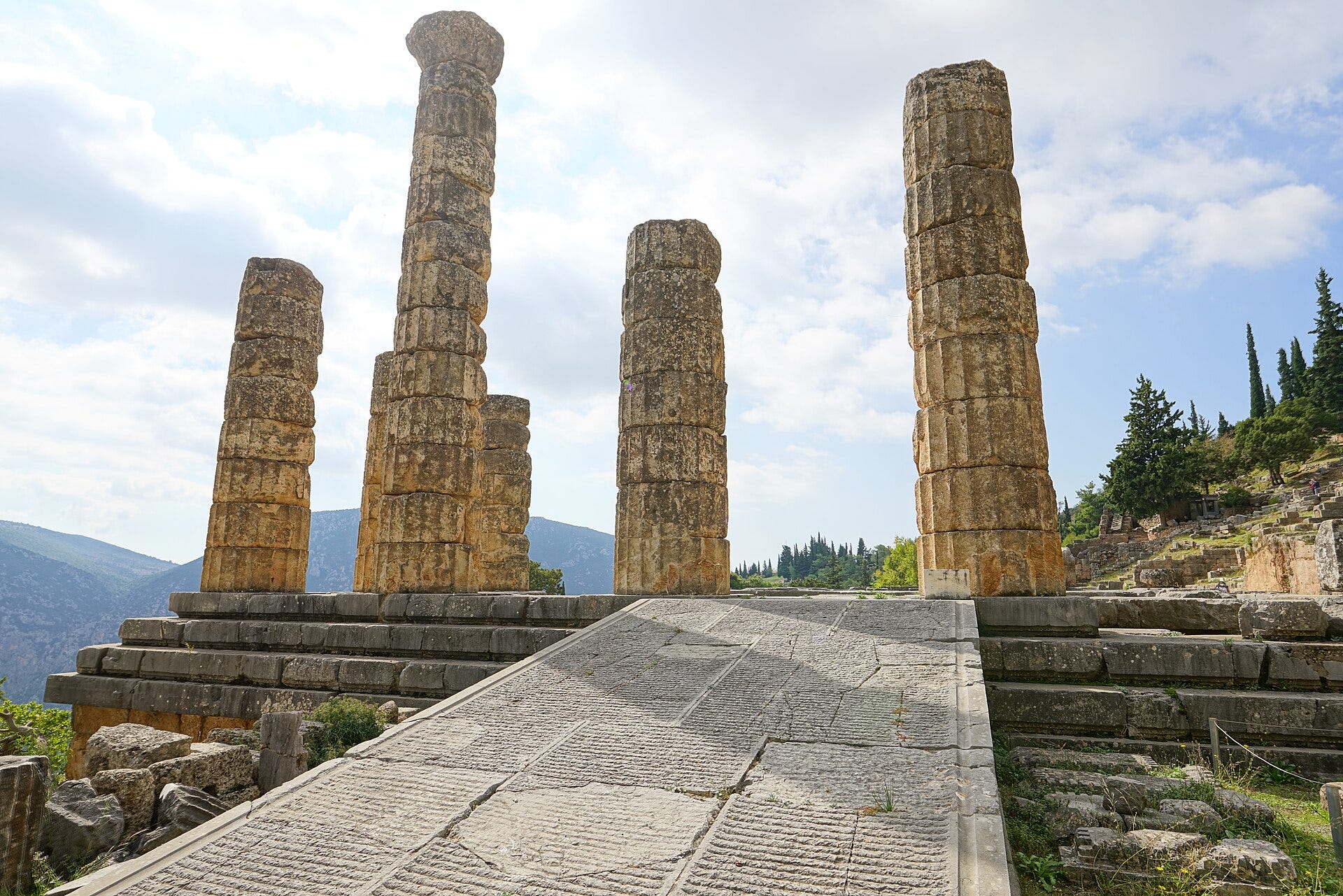
Croesus, King of Lydia, had a question. The Persians, led by Cyrus, had just achieved an important victory and had the look of a budding imperial power. Croesus wanted to know, should he attack this potential rival preemptively?
This story comes from Herodotus, writing in the mid-5th century BC. From two and a half millennia ago, and likely much longer ago than that, people have obsessed over the possibility of knowing the future. Whether reading signs in charred and cracked animal bones, the positions of the stars, or complex mathematical models trained on terabytes of historical data, people want to know: What is going to happen?
It’s a tired observation at this point to state that we live in particularly unpredictable times. During the COVID-19 lockdowns I kept a sticky note near my computer where I noted down the number of times I read or heard the word ‘unprecedented’ (I stopped after it had been completely filled with hash marks after about 3 months). But this doesn’t seem to have tempered our hope that we can find someone who knows the answer. While we might not consult animal bones or mythical oracles, we have a never-ending stream of op-ed columnists, TV talking heads, and online pundits spewing forecasts into the ether to be lapped up by eager audiences.
And yet, there has been some progress in the art and science of prediction. While the average pundit may be no better than rolling dice when it comes to predicting future events, we have solid evidence of so-called superforecasters who can predict geopolitical events with surprising accuracy. We in the US and in most other powerful countries have massive intelligence operations dedicated in no small part to answering questions eerily similar to the one Croesus was concerned about. Like: if we launch a preemptive attack in Persia, will it work?
Whether it’s possible or not, we want to see the future. And with modern methods of increasing sophistication, not least of which are machine learning and surprisingly powerful AI models, it seems like we might soon have this power within our grasp.
Seeking answers
Despite working on this problem around 550 BCE, King Croesus was surprisingly scientific in his attempts at predetermination. He sent messages to half a dozen famous oracles across the Hellenic world, with the intent of testing their powers before putting forth his most important question. After conducting this experiment, he became convinced that the Oracle at Delphi alone possessed a strong connection to the gods and therefore the one true power of foresight. He would shower these oracles with riches, and in return receive answers that would shape his empire.
2,575 years later, we have dispensed with the superstitious belief in the inscrutable Oracle at Delphi with a direct connection to the gods. Instead, we are running a prophetic forecasting tournament of inscrutable AIs, who (not coincidentally, because nothing is coincidental) are living on Oracle servers, with a direct connection to some of the most powerful (or at least wealthy) organizations that have ever existed. The more things change, the more they stay the same.
I’m afraid this framing might come across as dismissive, but I actually love this tournament idea. I’m participating myself, despite having minimal experience with either LLMs or forecasting, because I think it sounds so interesting (and my forecasting bot is called ‘Delphi’, because of course it is). And I think there are good reasons to think LLMs could be particularly good at this type of forecasting. Much of the information available to human forecasters—outside of that available to state intelligence agencies—is sourced through the internet and therefore easily accessible by modern LLMs. Making a good prediction requires absorbing and distilling an enormous amount of this information, something AIs are generally quite useful for. Beyond that, many of these questions cannot be modeled explicitly, so matching the general ‘vibe’ of the evidence is sufficient to get a pretty good answer. These models can produce a lot of spurious reasoning, but so can humans, so I think it’s plausible that the kind of predictions produced in this kind of AI tournament might eventually prove more accurate than those produced by humans.
Aside from that, understanding the capabilities of these silicon-based lifeforms we are dumping ~1% of GDP into serving seems to me to be one of the most important tasks of the current era, particularly if you are at all interested in the possibility that their development could kill us all. And working in an area that has fascinated but eluded humans for millennia seems like a fun way to explore that. I expect much of this blog to be documenting that exploration. But… I’m not exactly sure how much I expect it to really give us what we want.
Predictably unpredictable
Famously, Croesus received his answer from the Oracle at Delphi. Should he send an army against the Persians, they said, a great empire will be destroyed. Emboldened by this prediction, Croesus rallied his strongest allies and clashed against the Persians. Again, the Oracle proved right in their prophecy. Unfortunately for Croesus, the empire that was destroyed was his own. The Persian leader Cyrus would come to be known as Cyrus the Great, founder of one of the most impressive empires to ever exist. Croesus, other than in this tale of misunderstood prophecy, would fade into obscurity.
This is pretty cute from the Oracle. A little bit of linguistic ambiguity flips the prediction on its head and leads Croesus to his doom. In the rational modern world we wouldn’t tolerate this mystical wishy-washy language (unless it was about AI, or crypto, or politics, or sports, or…) Fortunately we have a much more respectable form of ambiguity: statistics.
In theory everything that happens is part of an endless chain of cause-effect relationships, and if you knew perfectly how the stage was set you could know exactly what the outcome would be. In practice there is a functionally irreducible amount of uncertainty, and statistics can help us make far better decisions given this fact. Running a clinical trial to find that people die 37.2% less often when given some new treatment is incredibly valuable. But statistical answers are fundamentally uncertain, and what we really want when we consult an Oracle is a definitive statement. If Croesus attacks the Persians, will he win? If he’s told he has a 37.2% chance of victory, what should he do with that information?
Decisions
There are times when having precise statistical estimates, even if they are far from certain, is very valuable. Professional poker players report that they can really ‘feel’ the difference between a 30% chance and a 35% chance, and it’s relevant for them because they can easily calculate expected value for any given choice. We also have an entire sector of financial services that is essentially just converting statistical estimates into money.
It’s not so simple to convert probabilities into most important real-world decisions, especially when you only have one shot to make that choice, and those are the places we want oracles the most. If you are considering having children with your partner and want to know whether they’ll be happy and healthy, would an 80% chance satisfy you? A 60% chance? A 30% chance? You can think through a set of principles to make this kind of decision, something I’d like to write more on in the future, but ultimately it comes down to an intuitive judgment. It becomes more about philosophy than statistics.
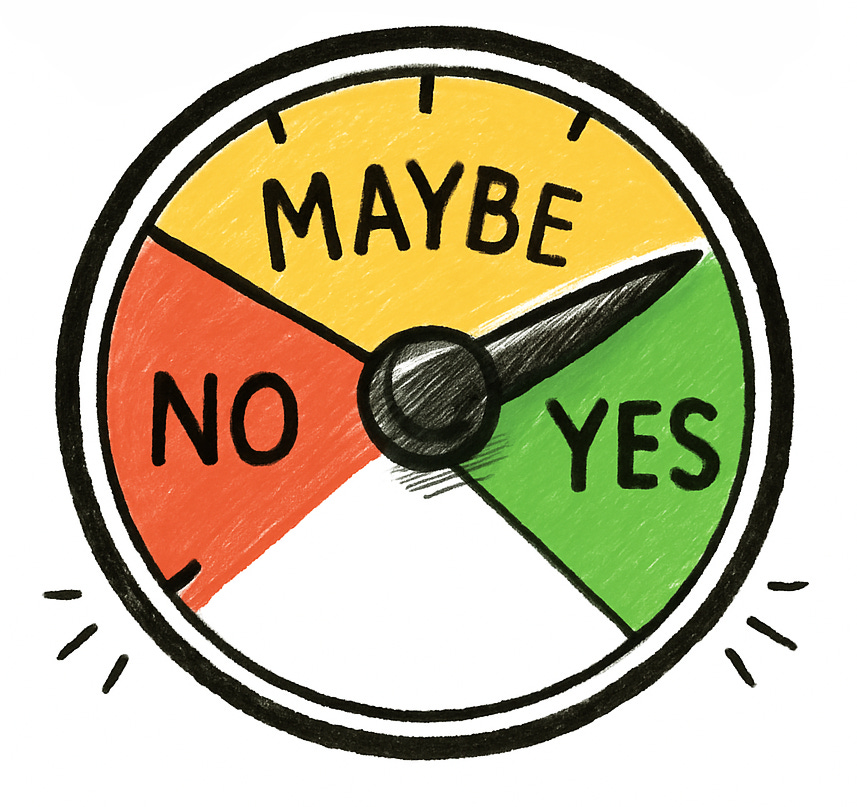
I think for most humans in most situations we have essentially three settings on our probability dial when asking if something will happen: yes, no, and maybe. If we are really thinking hard about something we might be able to add a couple of gradations in the form of ‘probably yes’ and ‘probably no,’ but getting too much beyond that starts to stink of imagined accuracy. Given a 37.2% chance, we’d just round that off to a ‘maybe’ or a ‘probably no.’ At a certain point you run into diminishing returns on forecast accuracy, and we might already be well past that point when it comes to converting those forecasts into decisions.
Still, I think there is value in trying to quantify this uncertainty if only to help yourself better understand the world, particularly when everything in that world is uncertain. Maybe if King Croesus was given a 37.2% chance of victory instead of a cryptic prophecy he would have made a different choice, or maybe not. But even without plugging this number into some complex decision model, I think it would have given him pause and pushed him to think about it a little more deeply. We’re not going to get oracles that tell us what’s going to happen, but maybe we can use their prophecies to make decisions just a little bit better.
Looking forward to making decisions just a little more informed! Thank you for this insightful overview.